Central Texas Metal Buildings

What gets built

Covered courts and indoor pickleball buildings around Austin

A covered court is a clear-span steel frame and a roof over a playing surface with the sides open; an indoor pickleball building is the same frame closed in with walls, doors and a conditioned interior.

A clear-span steel canopy over a court on a grass tract in Central Texas. Illustrative photograph, not a project record.

An independent local metal building contractor who works your county builds either one, and only the one who walks your lot prices it. Around Austin the choice moves more than the sheeting bill: closing the sides in brings the state commercial energy code.

Keep reading

Travis and Williamson counties then answer the permit question two different ways.

Inside Georgetown

Commercial building permit, 30 business day review

Georgetown requires a Commercial Building Permit application through My Government Online for new ground-up commercial construction, remodels, tenant finish-outs, additions and facade changes, with bookmarked PDF plans, the TDLR registration, a ComCheck and proof of transportation impact fees, and it will not accept the application until Planning has issued first-round site plan comments.

Source City of Georgetown Building Inspections, 300-1 Industrial Ave., read 2026-09-20.

Unincorporated Williamson County

No county building permit, building code or certificate of occupancy

Williamson County's own pages answer the building permit question by pointing to the County Engineer's Road and Bridge Division, which issues a Certificate of Compliance that verifies whether the property is in a floodplain, and say nothing else is needed from that office unless a driveway is being built.

The source was read and does not list this. Source Williamson County, frequently asked questions, infrastructure and developers, read 2026-09-20.

Williamson County, read at the county's and the city's own pages. Every county answers this on its own sheet. The whole record is on that county's sheet.

Open canopy court or conditioned court, and what does closing it in pull in?

Walls, a mechanical system and the state commercial energy code. The State Energy Conservation Office says the 2015 International Energy Conservation Code took effect November 1, 2016 for commercial buildings under its rule 34 TAC 19.53, and that it has kept that edition rather than a later one. Health and Safety Code 388.003(c) and (d) have each municipality administer and enforce the energy codes with code-certified inspectors and allow local amendments.

That is all the records here say about the energy code and a court. None addresses an open-sided canopy, and none says when a partly closed building becomes a conditioned one, so put that question to the office that enforces at your address before the frame is ordered.

Between the two sit the half measures: end walls only, a wind wall, roll-up doors, or a canopy framed with the girts in the package. Price the closed-in version first, because the frame is engineered for one case or the other.

SourcesTexas Comptroller of Public Accounts, State Energy Conservation Office, commercial and multi-family construction, read 2026-09-20; Texas Comptroller of Public Accounts, State Energy Conservation Office, local ordinances, read 2026-09-20.

A poured court is impervious cover before the roof goes on

Acres disturbed, not roof size, set the stormwater tier. TCEQ regulates construction under general permit TXR150000 by acreage: five or more acres, or part of a larger common plan of development or sale that will reach five, is a large construction activity; one to under five is a small one; and under one acre, outside such a plan, is not regulated.

Impervious cover bites sooner than the acre in Travis County, whose Non-Residential Development Checklist, revised May 11, 2023, sets possible permanent water quality controls above 10,000 square feet of new impervious cover, an environmental resource inventory above 10,000 square feet of disturbance, and a 45 percent impervious cover limit unless the driveway is on a state road.

SourcesTexas Commission on Environmental Quality, stormwater general permit for construction activities (TXR150000), read 2026-09-20; Travis County TNR, non-residential development checklist, read 2026-09-20.

Do covered courts and indoor pickleball buildings in Central Texas register with TDLR?

If the building falls in a category the accessibility law names and the project costs $50,000 or more, yes. Government Code 469.003 lists the buildings the law reaches, and two are privately funded: a public accommodation under the federal Americans with Disabilities Act constructed, renovated or modified on or after January 1, 1992, and a commercial facility under that Act on or after September 1, 1993. TDLR says a project under $50,000 in estimated cost is not submitted for registration or plan review, though the Texas Accessibility Standards still apply to it, and one of $50,000 or more submits a full set of construction documents under Administrative Rule 68.50.

Whether a club that sells memberships, a court at a school or a court in a public park is one of those categories is a determination about that building and that use, and nothing here makes it for you. What follows a registration is on the TDLR guide.

SourcesTexas Legislature Online, Government Code Chapter 469, elimination of architectural barriers, read 2026-09-20; Texas Department of Licensing and Regulation, Architectural Barriers frequently asked questions, read 2026-09-20.

Inside a city or outside it, which office permits the court?

The answer flips at the city line, and a court complex usually wants land outside one. Inside Austin a building permit is required to erect, construct, enlarge or alter any building within the city zoning jurisdiction, and commercial projects are reviewed under the 2024 International Building Code with local amendments.

Outside the cities, read the county. Travis County requires a Development Permit, and a commercial project that is not a dwelling files the Development (Non-Residential) permit with a sealed construction cost estimate and a site plan sealed by a Texas-licensed engineer. Williamson County publishes the opposite answer: its own pages state that the county issues no building permits and has no authority to issue a certificate of occupancy.

That is an absence on the county pages, not an absence of rules. Unincorporated Williamson County has used the 2018 International Fire Code and the Williamson County Fire Code since November 2020, and it requires a Fire Marshal permit before construction of a commercial establishment or public building starts. More on the Austin and Travis County permit guide and building a metal building in the Austin area.

Each jurisdiction in its own words, 2026-09-20.

On a phone this table scrolls sideways.

Where the lot isThe permit for the buildingWhat else the record names
Inside AustinA city building permit for any building in the zoning jurisdiction, under the 2024 International Building Code with local amendmentsTarget review from July 15, 2026: seven business days to 10,000 square feet, 10 to 25,000, 20 above
Unincorporated Travis CountyA Development (Non-Residential) permit, a sealed cost estimate and an engineer-sealed site planThe pages state no building code edition for the permit
Unincorporated Williamson CountyNo county building permit, building code or certificate of occupancy is listedA Fire Marshal permit before construction; plan review for a new building at $125 per 1,000 square feet; no occupancy until a certificate of compliance

SourcesCity of Austin Development Services, commercial plan review, read 2026-09-20; The source was read and does not list this.Williamson County, frequently asked questions, infrastructure and developers, read 2026-09-20; Williamson County Fire Marshal, construction permits, and the Williamson County Fire Code, second edition, read 2026-09-20; Travis County TNR Development Services, Commercial Site Plan, read 2026-09-20.

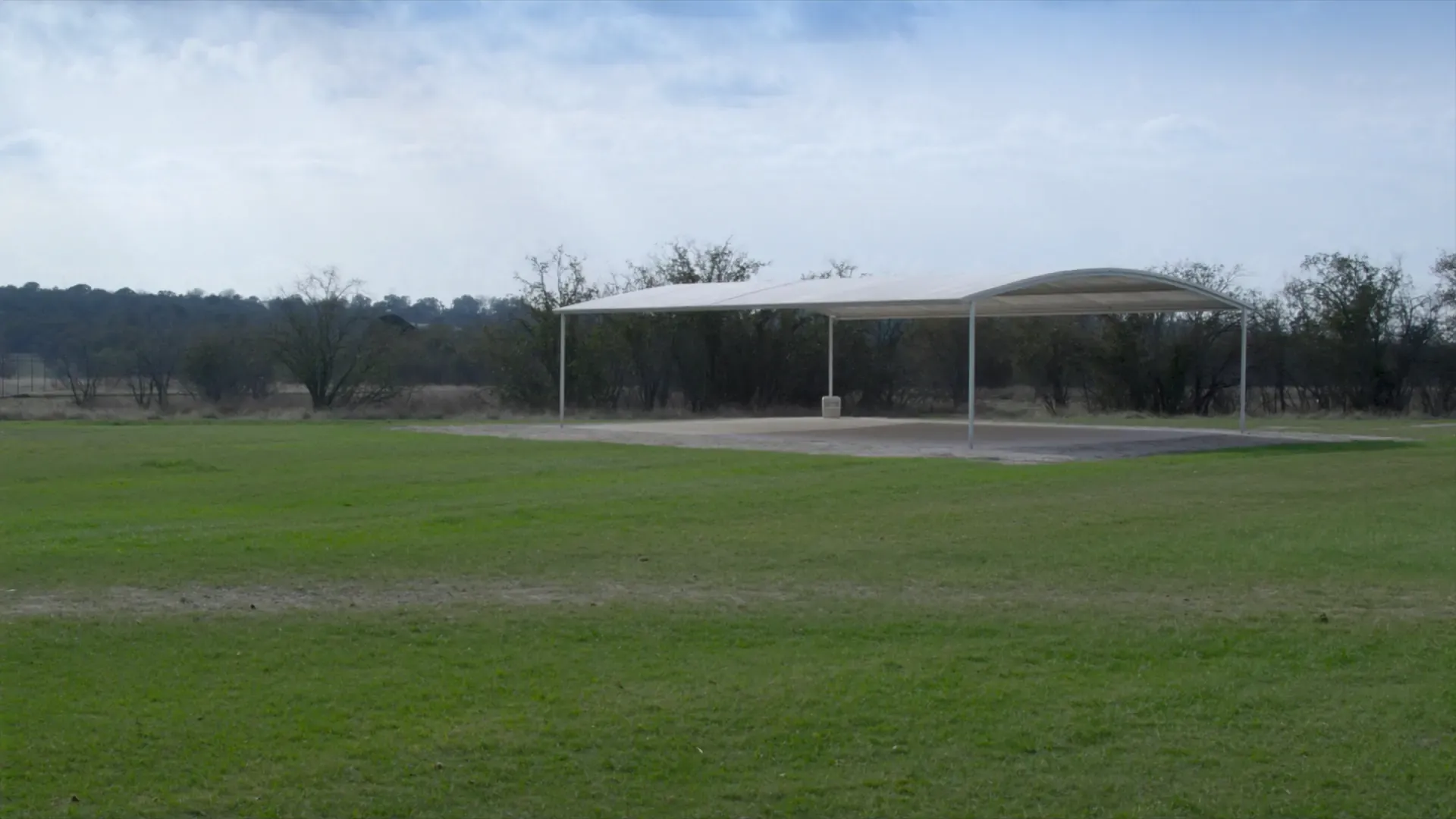
Clear span and eave height are settled before the frame is ordered

A court building is a clear-span problem: a floor with no columns standing in the play. Occupations Code 1001.056(a)(2)(F) exempts from engineering licensing the plans for a one-story building of not more than 5,000 square feet with no clear span greater than 24 feet on the narrow side, where no engineering services are offered to the public. Under 1001.056(b), where such a building has unsupported spans over 24 feet, only the trusses, beams or other roof supporting members have to be engineered or pre-engineered. A court span passes 24 feet well before the roof goes on, so a Texas professional engineer is on those sheets.

Height is the second number: the eave follows the clearance the sport needs plus the lights, and raising an eave after the steel is cut is a new order, not a change.

SourceTexas Legislature Online, Occupations Code Chapter 1001, engineers, read 2026-09-20.

Asked before pricing

Does an indoor pickleball building have to register with TDLR?

If it is a public accommodation or a commercial facility under the federal Americans with Disabilities Act and the estimated cost is $50,000 or more, yes. TDLR says a project at that line submits a full set of construction documents under rule 68.50, and one under $50,000 is not submitted, though the Texas Accessibility Standards still apply.

Who builds covered courts and indoor pickleball buildings in Central Texas?

An independent local metal building contractor who works your county sets the frame and sheeting and coordinates the slab. A Texas professional engineer is on the roof supporting members, because a court span passes the 24-foot clear span the engineering statute exempts. Only the contractor who walks your lot can price it.

Does a covered court need a county permit in unincorporated Williamson County?

Williamson County states on its own pages that it issues no building permits and has no authority to issue a certificate of occupancy, and no page read lists a building code or permit fee for a commercial structure. A commercial establishment or public building still takes the Fire Marshal fire code permit before construction starts.

Can an open canopy court be closed in later?

Yes, if the frame was designed for it. Wind load on an enclosed building is not the wind load on an open one, so have the closed-in version engineered and priced alongside the canopy. Closing it in also brings walls, a mechanical system and the state commercial energy code, which each municipality enforces.

Free estimate, six questions

Price covered courts and indoor pickleball buildings in Central Texas

The county tells a contractor which permit office your lot answers to. The building and the timing tell them what to look at first. Pricing it is free, and you owe nothing either way.

By submitting this form, I agree that Central Texas Metal Buildings and a metal building construction contractor may contact me at the phone number and email address I provided, including by automated phone calls and prerecorded messages, regarding metal building construction services. Consent is not a condition of any purchase. Message and data rates may apply. I may opt out at any time by asking to be removed during any call or by replying to any email. See our Privacy Policy.

Your request goes to an independent local metal building contractor serving Central Texas, not a national lead list.

Ready to put a price on the building?

Your request goes to an independent local metal building contractor serving Central Texas, not a national lead list. Pricing it is free, and you owe nothing either way.

Last reviewed 2026-09-20.

Price my building