Central Texas Metal Buildings

Permits and process, 39 primary sources

What a metal building costs in Central Texas, and why no site can quote yours

Only the independent local metal building contractor who walks your lot can price a finished building in Travis, Williamson, Bastrop, Caldwell, Lee or Burnet County, because no contractor whose own site names Austin or these six counties publishes one.

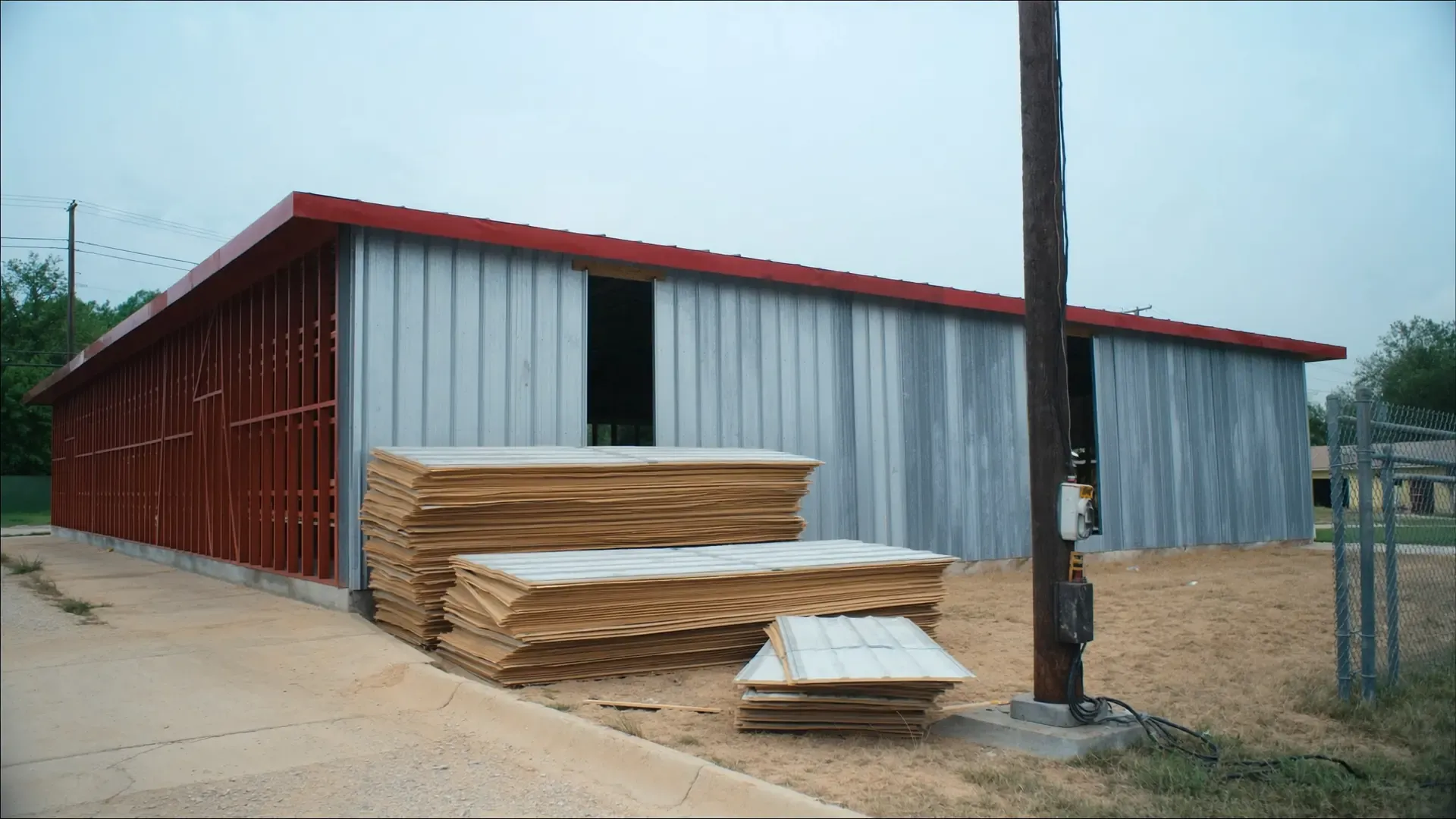
Wall panels stacked beside a metal building partway through sheeting in Central Texas. Illustrative photograph, not a project record.

What can be priced before that walk is the paperwork: the permit, review and registration fees the state agencies and the six counties publish, each printed here with its source and the day it was read. Between those sits the part of the number that moves, the span, the height, the doors, the slab and the site work.

Keep reading

The one dollar figure this footprint's record holds for the steel itself is a Texas manufacturer's kit price, and it prints only inside the labeled box below, with everything it leaves out beside it.

Inside Luling

City permit for all construction, storage buildings named

Luling requires a permit for all construction and installation projects in the city, residential and commercial, including new buildings, additions, foundations, driveways and storage buildings, with plan review and inspections by a contract engineering firm.

Source City of Luling permits and inspections, 509 E. Crockett St. (mailing), 2510 E. Pierce St. (physical), read 2026-09-20.

Unincorporated Caldwell County

County site construction permit for commercial work; no county building code

The Caldwell County Development Ordinance, adopted March 24, 2020 and amended February 14, 2023, requires a construction permit with engineer-certified drawings before land clearing or construction for any subdivision or site construction, with commercial site plans approved by the County Engineer.

Source Caldwell County Development Ordinance, revised February 14, 2023, and the subdivision and development fee schedule, read 2026-09-20.

Caldwell County, read at the county's and the city's own pages. The whole record is on that county's sheet.

What drives metal building cost in Central Texas?

Size first, then span, then everything that hangs on the frame. The footprint and the eave height set how much steel the manufacturer runs, and the clear span sets how heavy each frame has to be, because a wider span carries the roof with no column in the middle. In the order a contractor reads them:

  • Footprint and eave height: the steel itself.

  • Clear span and bay spacing: the weight of each frame.

  • Openings: every roll-up door, sectional door, walk door and window is a framed opening the manufacturer prices and the erector sets.

  • Insulation and conditioning: whether the building is heated and cooled, which brings the energy code with it.

  • The slab: priced by the ground under it, not by the square foot.

  • Site work: clearing, the pad, drainage, the driveway and its culvert.

  • Utilities and septic: the extension to a lot with no service, and a system where there is no sewer.

  • Paperwork: the permit, review and registration fees, the only line anyone can quote before a contractor is chosen.

SourceTexas Comptroller of Public Accounts, State Energy Conservation Office, commercial and multi-family construction, read 2026-09-20.

Why can no site quote a price for a metal building around Austin?

Because nobody who builds here publishes one. Every metal building contractor whose own site names Austin or one of these six counties offers an estimate by form or phone and prints no price for a specified building, read at the builders' own pages on 2026-09-20. Two Texas builders that do print prices name no Austin-area county, so their figures do not print here, and a per-square-foot range copied from a content site is not a source either.

The second reason is that the number is not one number. A bid prices the frame, the slab, the erection, the doors, the site work and the paperwork as one figure for one lot, and the slab and the site work cannot be priced from a desk. A slab on the deep clay east of Austin and a slab on the shallow rock west of it are different designs, and so is a pad on the sandy ground out toward Giddings; the slab and foundation guide carries the county soil surveys that say why.

The third reason is who does the work. No state license exists in Texas for anyone who builds a house or works as a general contractor, and the Texas Residential Construction Commission's Act expired September 1, 2009, so there is no licensed-contractor rate to point at. The contractor who walks the lot reads the drawings and writes the price, and pricing it costs nothing. Where that walk sits in the whole path, from the jurisdiction question to the steel, is the Austin-area metal building guide.

SourcesThe builders' own pages were read and print no such price.Seven Texas metal building company websites, five of them naming the Austin area, read 2026-09-20; Texas Department of Licensing and Regulation, regulated industries, and the Sunset Advisory Commission on the Texas Residential Construction Commission, read 2026-09-20.

The one published figure, and everything it leaves out

One Texas manufacturer prints kit prices on its own site, and its branch pages list stores in Bastrop, in Marble Falls, and in Spicewood, which the manufacturer calls its West Austin branch, all inside this footprint. Its figures for a 30 by 40 by 12 foot workshop and a 40 by 60 by 16 foot barn print in the labeled box further down this page with the source and the date they were read, and they are the only dollar figures for steel that print anywhere on this site.

Read what the price covers before reading the price. It is the building kit only: tax and freight are not included, the door is not included, the manufacturer says it does not provide the foundation or offer installation or erection, and prices are subject to change without notice. The kit figure is the steel on a truck; the slab, the erector, the doors, the site work, the utilities and the permit fees all sit outside it.

For an owner who buys the package and needs the rest, steel erection for a pre-engineered package is the service page: the slab, the anchor bolts and the crew that stands the frames. For an owner who wants one number for the whole building, a metal shop or workshop is the building most often priced on this footprint, and one bid from an independent local contractor covers the kit line and every line the kit leaves out.

SourceMueller, Inc., Standard Series Big Workshop 30 x 40 x 12 and Big Barn XL 40 x 60 x 16 product pages, and its Texas branch location pages, read 2026-09-20.

Which state agency fees can be priced before a contractor is chosen?

The ones the agencies publish on their own fee pages, printed here as read on 2026-09-20. Three state agencies can touch a metal building on this footprint: TDLR on the $50,000 accessibility line, TCEQ on construction stormwater and, in Travis and Williamson counties, on the Edwards Aquifer plan, and TxDOT on a driveway onto a state highway. The stormwater notice belongs to a site that disturbs five acres or more or is part of a larger common plan that will, and the aquifer fee to a lot on a regulated zone, which only TCEQ's official maps decide.

State agency fees as each agency's own page states them, read 2026-09-20.

On a phone this table scrolls sideways.

Agency and itemPublished feeWhat the page says about the rest
TDLR project filing, estimated construction cost of $50,000 or more$175Priced off the construction cost estimate, with no schedule of tiers printed for either one
TDLR late project filing$300In place of the $175 filing fee when a project is registered after construction is complete, plus the plan review fee
TDLR special project registration, under $50,000$175, non-refundablePlan review or inspection fees go to a registered accessibility specialist, who sets and collects its own fees
TCEQ stormwater Notice of Intent, five acres or more$225 electronic, $325 paperNo separate annual fee; a site of one to under five acres files no notice and pays no fee under the site notice option
TCEQ Edwards Aquifer plan, non-residential site, Travis and Williamson$3,000 under one acre; $4,000 from one to under five acresTiers continue to $10,000 at 100 acres or more; one single family dwelling under five acres pays $650
TxDOT driveway permit onto a state highwayNo fee statedThe Access Management Manual states no permit fee and no review period; the only time figure is the 24-hour notice before construction

SourcesTexas Department of Licensing and Regulation, Architectural Barriers fee schedule, read 2026-09-20; Texas Department of Licensing and Regulation, Special Project Registration Application, form EAB-Compliance-245N-E, read 2026-09-20; Texas Commission on Environmental Quality, TPDES general permit TXR150000, 2023 construction general permit, Part IX, read 2026-09-20; Texas Commission on Environmental Quality, stormwater discharges from small construction activities, site notice steps, read 2026-09-20; Texas Commission on Environmental Quality, stormwater general permit for construction activities (TXR150000), read 2026-09-20; Texas Commission on Environmental Quality, application fee form TCEQ-0574, Edwards Aquifer Protection Program, read 2026-09-20; The agency pages were read and describe no written parcel determination.Texas Commission on Environmental Quality, Edwards Aquifer map viewer, read 2026-09-20; The manual was read and states no fee and no review period.Texas Department of Transportation, Access Management Manual, chapter 2 section 4, permits, read 2026-09-20.

What each county charges for the permits its own site lists

Each county publishes its own fee or none, and the table prints each one from that county's own page. Inside a city the city's own schedule applies instead, and the county pages for Travis, Williamson, Bastrop, Caldwell, Lee and Burnet print what each city's page was read to say. Publishing no building permit fee does not leave a county free of charges: the septic, floodplain and driveway permits each carry their own where the county lists them.

The Williamson row is the cheapest line on the table, not the cheapest building: the county's own pages say it issues no building permits and reviews almost no site plans, so there is no county plan review fee, while the Fire Marshal's plan review, the $50,000 accessibility line and the septic and floodplain desks still apply. Burnet County is close behind it, pricing a Class A permit at $25 for a lot outside any flood hazard area. Austin is the other end: inside the city, the FY 2025-26 commercial plan review fee schedule starts at a base of $2,949.82 up to 1,500 square feet and steps up by square footage, plus a $176.76 application processing fee and a $250 fire building permit review, paid at submittal and non-refundable. A low county fee tells you how much the county reads, not what the building costs.

County fees as each county's own page states them, read 2026-09-20. Inside a city, the city's schedule applies instead.

On a phone this table scrolls sideways.

CountyBuilding or development permit outside the citiesCounty fire code permitDriveway onto a county road
TravisNon-residential development permit $137 per application plus $1.99 per $1,000 of construction valuation outside the Austin ETJ, or $66 plus $1.99 per $1,000 inside it, FY2026; from October 1, 2026, $158 plus $2.29 per $1,000 with a $15 IT service feeFire Marshal building permit tiered by construction value: $790 under $200,000; $790 plus $1.75 per $1,000 from $200,000 to under $1,000,000; higher tiers above that$165, rising to $190 on October 1, 2026
WilliamsonNo county building permit, building code or certificate of occupancy listed. A $25 Certificate of Compliance verifies that no 100-year floodplain exists at a structure outside a floodplainFire Marshal plan review for a new commercial building $125 per 1,000 square feet, rounded up; $150 civil or site plan fire lane review; $100 Certificate of Compliance final inspectionPermit required; neither the Road and Bridge page nor the Driveway Policy states a dollar fee, and fees are invoiced after review
BastropCommercial development permit $500 base plus $0.05 per building square foot plus $0.03 per square foot of impervious paving, capped at $25,000The county lists no fire marshal, no fire code and no fire code permit$50, or $75 if the driveway is built without a permit
CaldwellSite Construction Permit $500 under $10,000 of construction cost; $500 plus $15 per $1,000 above $10,000 up to $1 million; doubled if work starts before approvalFrom August 13, 2026: $480 for a building up to 5,000 square feet; $672 plus $0.05 per square foot above 5,000; covers plan review, the permit and up to two inspectionsWork in the Public Right-of-Way Permit required, on the same form as the floodplain application; no fee is recorded here
LeeDevelopment Permit for any individual structure larger than 100 square feet; no fee is recorded hereNo fire code or fire marshal on the Development Services page, and none on the county office list$150 for a commercial drive, $25 for a private one, plus $15 per foot of culvert; $500 commercial or $100 private penalty for installing without a permit
BurnetClass A outside any flood hazard area $25; Class B inside one $400, where the packet adds a site plan showing the flood zone and either a surveyor's elevation certificate or an engineer's letter. The page describes neither plan review nor a structural inspectionNot recorded hereThe county pages read list no driveway or culvert permit for a county road; a driveway onto a state highway is a TxDOT matter

SourcesTexas Department of Licensing and Regulation, Architectural Barriers frequently asked questions, read 2026-09-20; City of Austin Development Services, commercial building plan review and inspection permit fees (FY 2025-26) and the commercial building application checklist, read 2026-09-20; Travis County TNR, FY2026 and FY2027 development related fee schedules, read 2026-09-20; Travis County Fire Marshal, permits and plan reviews, and Travis County Code Chapter 201, read 2026-09-20; Travis County TNR Development Services, commercial driveway permit, read 2026-09-20; The source was read and does not list this.Williamson County, frequently asked questions, infrastructure and developers, read 2026-09-20; Williamson County, floodplain management, and the Certificate of Compliance form, read 2026-09-20; Williamson County Fire Marshal, construction permits, and the Williamson County Fire Code, second edition, read 2026-09-20; Williamson County, Road and Bridge, and the Williamson County Driveway Policy, read 2026-09-20; Bastrop County Development Services, and the Development Services application fees, read 2026-09-20; Bastrop County Development Services, application fees and residential driveway requirements, read 2026-09-20; Caldwell County Development Ordinance, revised February 14, 2023, and the subdivision and development fee schedule, read 2026-09-20; Caldwell County Fire Code adopted August 13, 2026, and the order adopting it, read 2026-09-20; Lee County Development Services Department, read 2026-09-20; Lee County requirements for permits to construct access driveways on county right of way, read 2026-09-20; Burnet County, on-site sewage facilities and development permits, read 2026-09-20; The source was read and does not list this.Burnet County, Development Services, read 2026-09-20.

Does the $50,000 accessibility line add to the cost?

Yes, for a business building at an estimated construction cost of $50,000 or more, and the fees are the smaller part of it. TDLR says a project whose total estimated cost is under $50,000 is not submitted for registration or plan review, though the Texas Accessibility Standards still apply to it, and a project of $50,000 or more submits a full set of construction documents under its Rule 68.50; Government Code 469.101 puts that line in statute for a covered building. A single-family home is not among the covered categories. A building that is a public accommodation or a commercial facility under the federal Americans with Disabilities Act is.

What counts toward the $50,000 is narrower than the whole project. TDLR's special registration form says the estimated cost that decides the question excludes site acquisition, architectural, engineering or consulting fees, furnishings, and equipment that is not part of the building mechanical systems.

What the line adds: the $175 project filing fee, plan review and inspection fees TDLR sets by estimated construction cost and publishes no tiers for, and design time, because Government Code 469.102 puts the duty to submit on the architect or engineer with overall design responsibility, due within 20 days after the plans are issued. The owner may not apply for a local building permit before the plans are submitted, and a local permit official may not accept the application until registration is verified. A project registered after construction is complete pays the $300 late filing fee in place of the $175, plus the plan review fee, and an inspection within one year of completion is the owner's responsibility under 469.105. The TDLR registration guide walks the sequence.

SourcesTexas Department of Licensing and Regulation, Architectural Barriers frequently asked questions, read 2026-09-20; Texas Legislature Online, Government Code Chapter 469, elimination of architectural barriers, read 2026-09-20; Texas Department of Licensing and Regulation, Special Project Registration Application, form EAB-Compliance-245N-E, read 2026-09-20; Texas Department of Licensing and Regulation, Architectural Barriers fee schedule, read 2026-09-20.

Who seals the drawings, and where that cost line starts

A sealed set is a cost line, and state law sets where it starts. Occupations Code 1001.056 exempts from engineering licensing the plans for a building of no more than one story with a total floor area of not more than 5,000 square feet and no clear span between supports greater than 24 feet on the narrow side; over 24 feet, only the trusses, beams or other roof supporting members have to be engineered or pre-engineered. A private building used exclusively for farm, ranch or agricultural purposes is exempt, and so is a private dwelling and a garage pertinent to one, though 1001.056(c) withdraws the exemption for a residential slab on expansive soil unless the work meets the International Residential Code as applied in the jurisdiction. A pre-engineered package carries the manufacturer's engineering for the frames; the foundation and the site are separate sheets, and where the exemption does not reach them a Texas professional engineer seals them.

Occupations Code 1051.606 exempts a privately owned commercial building of no more than two stories or 20,000 square feet, a warehouse with limited public access, and privately owned buildings used primarily for farm, ranch or agricultural purposes, so a shop or a warehouse inside those limits needs no architect's seal under state law. Inside Austin, all plans for work in a building or portion of a building over 5,000 square feet have to be sealed by a professional engineer under Building Criteria Manual 1.8.0, and new construction lists structural plans with a site-specific geotechnical report, a cost line of its own that the slab design reads from.

Conditioning adds a code. The State Energy Conservation Office says the 2015 International Energy Conservation Code took effect November 1, 2016 for commercial buildings and that it has kept the 2015 edition, each municipality enforces it and may adopt local amendments, and Austin lists the 2024 edition among the codes effective July 10, 2025. An open equipment shed brings none of that; a conditioned shop brings all of it.

SourcesTexas Legislature Online, Occupations Code Chapter 1001, engineers, read 2026-09-20; Texas Legislature Online, Occupations Code Chapter 1051, architects, read 2026-09-20; City of Austin Development Services, commercial building plan review and inspection permit fees (FY 2025-26) and the commercial building application checklist, read 2026-09-20; Texas Comptroller of Public Accounts, State Energy Conservation Office, commercial and multi-family construction, read 2026-09-20; Texas Comptroller of Public Accounts, State Energy Conservation Office, local ordinances, read 2026-09-20; City of Austin Development Services, building technical codes, read 2026-09-20.

The financing programs, by name

Three programs are named here, hedged on purpose, and not priced, because the agency's own page is the current one and amounts, terms and eligibility change. Each may be offered to an owner who qualifies; none is promised.

  • The SBA 504 loan, from the U.S. Small Business Administration, may be used for the purchase, construction or renovation of buildings or land and for long-term machinery and equipment. The SBA's page says it cannot be used for working capital, inventory, or speculation or investment in rental real estate.

  • The SBA 7(a) loan lists acquiring, refinancing or improving real estate and buildings among its permitted uses, including acquiring land and building or renovating a building.

  • The USDA Farm Service Agency's Farm Ownership Loans cover the purchase of farmland, the construction of farm buildings, and improvements to existing structures, with applications through the local FSA office. Whether a given equipment barn qualifies is that office's call.

  • One federal rule sits under both SBA programs. 13 CFR 120.131 requires the borrower to occupy a set share of the building the loan finances, with a higher share for new construction than for an existing building and a limited part of a new building allowed to be leased. The shares are on the linked rule, not here.

SourcesU.S. Small Business Administration, 504 loans, and the 504 loan program fact sheet for borrowers, read 2026-09-20; U.S. Small Business Administration, 7(a) loans, and the SBA lender resources page, read 2026-09-20; USDA Farm Service Agency, Farm Ownership Loans, and the Farm Loans Overview fact sheet (October 2025), read 2026-09-20; Office of the Federal Register, eCFR, 13 CFR 120.131, read 2026-09-20.

The only published figures

Mueller, Inc., a Texas manufacturer headquartered in Ballinger, prints kit prices on its own site. Its Standard Series Big Workshop, 30 by 40 by 12 feet, lists at $14,395 (on sale at $12,995) in the utility grade and $16,695 (on sale at $14,995) in the premium grade; its Big Barn XL, 40 by 60 by 16 feet, lists at $28,995 (on sale at $26,095) and $36,995 (on sale at $33,295). The prices are for the building kit only: tax and freight are not included, the door is not included, and Mueller says it does not provide the foundation or offer installation or erection. Prices are subject to change without notice. Mueller's branch pages list stores in Bastrop, in Spicewood (its West Austin branch) and in Marble Falls, all inside this footprint.

Source Mueller, Inc., Standard Series Big Workshop 30 x 40 x 12 and Big Barn XL 40 x 60 x 16 product pages, and its Texas branch location pages, read 2026-09-20.

Asked before pricing

Why will no number on this page be your number?

There is no published price to give you. No metal building contractor whose own site names Austin or Travis, Williamson, Bastrop, Caldwell, Lee or Burnet County prints a price for a finished building, read at their own pages on 2026-09-20. The number depends on the footprint, the eave height, the clear span, the doors, the insulation, the slab the ground calls for, the site work, the utility extension and the agency fees, and only an independent local contractor who walks your lot can put it together. Pricing it is free.

Is a manufacturer's kit price the price of the building?

No. The one kit price in this footprint's record covers the building kit only: the manufacturer says tax and freight are not included, the door is not included, it does not provide the foundation or offer installation or erection, and prices are subject to change without notice. The slab, the erector, the doors, the site work, the utilities and the permit fees all sit outside that figure, and one bid from an independent local contractor is what puts them together.

Which metal building fees around Austin are published before a contractor is chosen?

The ones the agencies and counties print on their own pages. TDLR publishes its project filing fee and its late filing fee for a project at $50,000 or more, TCEQ publishes the stormwater Notice of Intent fee for a site of five acres or more and the Edwards Aquifer plan fee by acreage, and each of the six counties prints its own permit fee or lists none. Every one prints on this page with its source and read date, and inside a city the city's schedule applies instead.

Can an SBA or USDA loan pay for a metal building around Austin?

It may. The SBA 504 loan may be used for the purchase, construction or renovation of buildings or land, the SBA 7(a) loan lists improving real estate and buildings among its permitted uses, and the USDA Farm Service Agency's Farm Ownership Loans cover the construction of farm buildings, with applications through the local FSA office. Amounts, terms and eligibility change, so the agency page linked on this page is the current one, and nothing here is a promise of approval.

Free estimate, six questions

Price a metal building on your land

The county tells a contractor which permit office your lot answers to. The building and the timing tell them what to look at first. Pricing it is free, and you owe nothing either way.

By submitting this form, I agree that Central Texas Metal Buildings and a metal building construction contractor may contact me at the phone number and email address I provided, including by automated phone calls and prerecorded messages, regarding metal building construction services. Consent is not a condition of any purchase. Message and data rates may apply. I may opt out at any time by asking to be removed during any call or by replying to any email. See our Privacy Policy.

Your request goes to an independent local metal building contractor serving Central Texas, not a national lead list.

Ready to put a price on the building?

Your request goes to an independent local metal building contractor serving Central Texas, not a national lead list. Pricing it is free, and you owe nothing either way.

Last reviewed 2026-09-20.

Price my building