Central Texas Metal Buildings

Permits and process, 24 primary sources

Pad grading and site prep for a metal building around Austin

Site prep for a metal building around Austin runs in a fixed order: the site plan and the county or city permit first, then clearing, then a pad graded so water leaves the slab on every side.

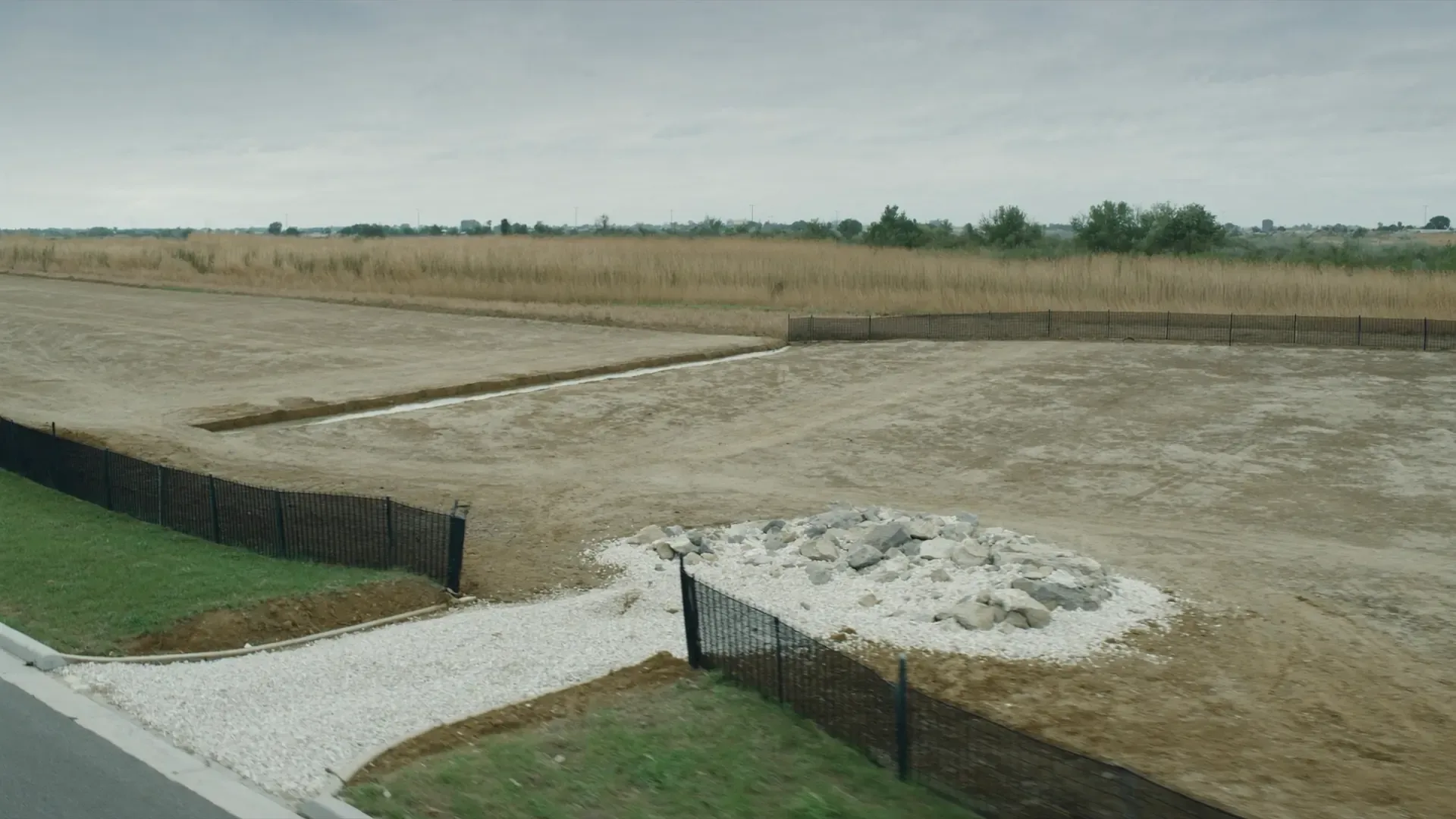
A graded building pad with silt fence and a crushed limestone entrance outside Austin, Texas. Illustrative photograph, not a project record.

What sets the paperwork is how much ground the work disturbs, which of the six counties the lot is in, and whether it sits inside a city. Disturb one acre and TCEQ's construction stormwater permit applies; at five acres a Notice of Intent and a fee go in as well.

Keep reading

In Travis County a commercial pad also meets the county's own checklist, and inside Austin the trees are regulated before one comes down.

Inside Georgetown

Commercial building permit, 30 business day review

Georgetown requires a Commercial Building Permit application through My Government Online for new ground-up commercial construction, remodels, tenant finish-outs, additions and facade changes, with bookmarked PDF plans, the TDLR registration, a ComCheck and proof of transportation impact fees, and it will not accept the application until Planning has issued first-round site plan comments.

Source City of Georgetown Building Inspections, 300-1 Industrial Ave., read 2026-09-20.

Unincorporated Williamson County

No county building permit, building code or certificate of occupancy

Williamson County's own pages answer the building permit question by pointing to the County Engineer's Road and Bridge Division, which issues a Certificate of Compliance that verifies whether the property is in a floodplain, and say nothing else is needed from that office unless a driveway is being built.

The source was read and does not list this. Source Williamson County, frequently asked questions, infrastructure and developers, read 2026-09-20.

Williamson County, read at the county's and the city's own pages. The whole record is on that county's sheet.

What does pad grading and site prep for a metal building involve around Austin?

Four steps, in order: a site plan showing where the building, the drive and the drainage go; the permit or certificate the county or city issues on it; clearing inside the limits of construction; and the pad, cut and filled to a level bench, compacted, and shaped so runoff moves away from the future slab instead of under it.

Whoever moves the dirt clears and grades it, and on this site that is an independent local metal building contractor who works your county. Where the county record calls for a sealed site plan, a Texas professional engineer seals it: Travis County's non-residential development permit takes a site plan sealed by a Texas-licensed engineer, Bastrop County's non-single-family permit a civil plan set stamped by one, and Caldwell County's commercial site construction permit engineer-certified drawings before land clearing.

The ground sets the price of the cut. West of the Balcones Escarpment, the 1974 Travis County soil survey names breaking and moving massive limestone for site leveling as the main urban limitation on the Tarrant soils, about eight inches deep over rock. East of it the Houston Black clays crack when dry and, in the survey's words, shrink and swell enough to damage foundations, so the pad's drainage matters as much as its level.

SourcesUSDA Soil Conservation Service, Soil Survey of Travis County, Texas (1974), climate and parent material sections, read 2026-09-20; USDA Soil Conservation Service, Soil Survey of Travis County, Texas (1974), general soil map and engineering uses of the soils, read 2026-09-20; USDA Soil Conservation Service, Soil Survey of Travis County, Texas (1974), general soil map, Brackett and Tarrant series, parent material, read 2026-09-20; Travis County TNR Development Services, Commercial Site Plan, read 2026-09-20; Bastrop County Development Services, and the Development Services application fees, read 2026-09-20; Caldwell County Development Ordinance, revised February 14, 2023, and the subdivision and development fee schedule, read 2026-09-20.

Grading is construction in the county records, so the permit comes before the clearing

None of the six county records treats the pad as a step before the paperwork.

  • Travis County: a development permit before any construction or development outside the cities, under Travis County Code Chapter 464, on scaled plans showing topography and the floodplain.

  • Williamson County: the county's own pages list no county building permit outside its cities. They do require a $25 Certificate of Compliance for all structures or other developments outside a floodplain, and construction is authorized only after county approval.

  • Bastrop County: a development permit for any external development, applied for before building or placing a structure; a non-single-family application carries a drainage report meeting the county's zero net increase in runoff policy.

  • Caldwell County: a construction permit with engineer-certified drawings before land clearing or construction, and commercial site construction means all construction, grading or added impervious cover not otherwise exempt.

  • Lee County: a Development Permit for any structure larger than 100 square feet, and no work in a special flood hazard area until the Floodplain Development Permit issues.

  • Burnet County: a 911 address, then the building permit: Class A outside any flood hazard area at $25 with no inspection, Class B inside one at $400 with an elevation certificate and a site plan showing the flood zone.

  • Inside Austin the file is the site plan, required for any site work on a non-residential site unless the project qualifies for an exemption, and the exemption for construction up to 1,000 square feet holds only when no tree over eight inches is removed and the work is outside the 100-year floodplain. In its extraterritorial jurisdiction Austin issues no new construction permit and sends the applicant to the county.

SourcesCity of Austin Development Services, site plans, exemptions and corrections, and Land Development Code 25-5-2 on Municode (Supp. No. 174), read 2026-09-20; City of Austin Development Services, relocation permit, and City of Austin Planning, jurisdictional matters, read 2026-09-20; Travis County TNR, floodplain maps, and Travis County Code Chapter 464, read 2026-09-20; The source was read and does not list this.Williamson County, frequently asked questions, infrastructure and developers, read 2026-09-20; Williamson County, floodplain management, and the Certificate of Compliance form, read 2026-09-20; Bastrop County Development Services, and the Development Services application fees, read 2026-09-20; Bastrop County Development Services, floodplain management, read 2026-09-20; Caldwell County Development Ordinance, revised February 14, 2023, and the subdivision and development fee schedule, read 2026-09-20; Lee County Development Services Department, read 2026-09-20; Lee County, floodplain development provisions and the Flood Damage Prevention Ordinance, read 2026-09-20; Burnet County, on-site sewage facilities and development permits, read 2026-09-20.

Which TCEQ stormwater tier does the pad fall in?

The acreage the work disturbs, not the size of the building, sets the tier. Under general permit TXR150000 a large construction activity disturbs five or more acres, a small one at least one but less than five, and work under one acre that is not part of a larger common plan is not regulated. The common plan is the catch: the total disturbed under one plan counts, so the pad, the drive and the parking apron add up, and TCEQ's own example of a project that grows from 0.93 to 1.08 acres moves into the one-to-five-acre tier.

On the large tier, provisional coverage begins immediately for an electronic Notice of Intent, or seven days after a paper one is postmarked. The permit took effect March 5, 2023 and expires March 5, 2028. A commercial metal building with its drive and parking can cross the acre line on the site work alone; an equipment or RV storage building on a ranch tract may stay under it. The whole sequence is on building a metal building in the Austin area.

TCEQ construction stormwater by acres disturbed, general permit TXR150000, read 2026-09-20.

On a phone this table scrolls sideways.

Acres disturbedTierFiles and postsFee
Under one, not part of a larger common planNot regulated by the permitNothing; the total under a larger plan still countsNone stated
One to under fiveSmall construction activityA pollution prevention plan before construction; site notice TCEQ-20963 posted two days before starting until final stabilization; no Notice of IntentNone required
Five or more, or part of a common plan that willLarge construction activityA pollution prevention plan; a Notice of Intent through STEERS; the large site notice until final stabilization; a Notice of Termination within 30 days after$225 electronic, $325 paper; no annual fee

SourcesTexas Commission on Environmental Quality, stormwater general permit for construction activities (TXR150000), read 2026-09-20; Texas Commission on Environmental Quality, stormwater discharges from construction activities, less than one acre, read 2026-09-20; Texas Commission on Environmental Quality, stormwater discharges from small construction activities, site notice steps, read 2026-09-20; Texas Commission on Environmental Quality, stormwater discharges from large construction activities, steps, read 2026-09-20; Texas Commission on Environmental Quality, TPDES general permit TXR150000, 2023 construction general permit, Part IX, read 2026-09-20.

In the Edwards Aquifer contributing zone the plan is approved before the pad is cut

Travis and Williamson are two of the eight counties TCEQ names for the Edwards Aquifer Protection Program, and the stormwater permit itself carries the hold: Part II.C.5 says construction at a site regulated under 30 TAC Chapter 213 may not begin until the Edwards Aquifer protection plan is approved.

Whether a pad needs a Contributing Zone Plan turns on two questions from TCEQ's own decision page: is the work a regulated activity under 30 TAC 213.22(6), and will it disturb at least five acres or is it part of a larger plan of development or sale. If not, no plan is needed. When one is, it is approved before construction begins and includes construction stormwater controls, which the TPDES pollution prevention plan can satisfy. Which zone a parcel sits on is whatever TCEQ's official maps show; the viewer is informational, no page read describes a written parcel determination, and the Austin Regional Office is (512) 339-2929. The clock and the fees are on the contributing zone guide.

SourcesTexas Commission on Environmental Quality, Edwards Aquifer Protection Program, read 2026-09-20; Texas Commission on Environmental Quality, TPDES general permit TXR150000, 2023 construction general permit, Part II.C.5, read 2026-09-20; Texas Commission on Environmental Quality, Edwards Aquifer Protection Program, what plans you might need, and the Contributing Zone Plan page, read 2026-09-20; The agency pages were read and describe no written parcel determination.Texas Commission on Environmental Quality, Edwards Aquifer map viewer, read 2026-09-20.

What does Travis County's checklist trigger on a commercial pad?

Six triggers, from the county's Non-Residential Development Checklist, revised May 11, 2023: a stormwater pollution prevention plan at one acre or more of disturbance; possible permanent water quality controls above 10,000 square feet of new impervious cover; an environmental resource inventory above 10,000 square feet of disturbance; a 45 percent impervious cover limit unless the driveway is on a state road; a city signature or permit before a county permit issues in any city's extraterritorial jurisdiction; and a traffic impact analysis determination worksheet for a new county driveway.

Read those against a pad. Ten thousand square feet of impervious cover is a 100 by 100 foot footprint, so a shop with a drive and an apron reaches the water quality and inventory lines well before the acre line for stormwater. The checklist is a county document for county permits, and the county's floodplain jurisdiction runs only outside city limits, so a lot inside a city answers to that city instead.

SourcesTravis County TNR, non-residential development checklist, read 2026-09-20; Travis County TNR, floodplain maps, and Travis County Code Chapter 464, read 2026-09-20.

Which trees can come out inside Austin, and does the rule reach the ETJ?

Inside Austin's full purpose and limited purpose jurisdictions, a tree 19 inches or more in diameter, measured 4.5 feet above the ground and of any species, is protected, and a tree permit is required to remove or impact one. A heritage tree is 24 inches or more and one of ten listed species, including all oaks, pecan, cedar elm and bald cypress; its removal is prohibited except as the code provides, and a variance for a tree 30 inches and larger goes through a public process. Every tree eight inches and larger is surveyed on a commercial site plan submittal, and the FY 2025-26 arborist site plan review runs from $1,180.71 for up to five trees to $3,815.92 for up to 200.

The ordinance does not apply in the extraterritorial jurisdiction, which the city describes as unincorporated land within five miles of its boundary and not inside another city. Austin issues no new construction permit there and sends the applicant to the county, and Travis County's checklist wants the city's signature or permit before the county permit issues in any city's ETJ.

SourcesCity of Austin Development Services, city arborist, and the tree review and inspection fees (FY 2025-26), read 2026-09-20; City of Austin Development Services, relocation permit, and City of Austin Planning, jurisdictional matters, read 2026-09-20; City of Austin Development Services, site plans, exemptions and corrections, and Land Development Code 25-5-2 on Municode (Supp. No. 174), read 2026-09-20; Travis County TNR, non-residential development checklist, read 2026-09-20.

Asked before pricing

Does pad grading and site prep need a permit in Williamson County outside the cities?

Williamson County's own pages list no county building permit, building code or certificate of occupancy outside its cities. Before construction the county does require a Certificate of Compliance, a $25 floodplain check for all structures or other developments outside a floodplain, or a Floodplain Development Permit where a regulated floodplain is within or adjacent to the work. A commercial building also needs the Fire Marshal's fire code permit.

How many acres of disturbance put a metal building pad under TCEQ stormwater coverage?

One. Under general permit TXR150000, disturbing at least one acre but less than five is a small construction activity: a pollution prevention plan and a posted site notice, no Notice of Intent and no fee. Five acres or more is a large construction activity, which files a Notice of Intent with a $225 electronic or $325 paper fee. Under one acre is not regulated unless the work is part of a larger common plan.

Can a heritage oak be removed for a metal building pad inside Austin?

Not as a matter of course. Inside Austin's full and limited purpose jurisdictions, a tree 24 inches or more in diameter and one of ten listed species, all oaks included, is a heritage tree; its removal is prohibited except as the code provides, and a variance for a tree 30 inches and larger goes through a public process. The ordinance does not apply in the extraterritorial jurisdiction.

Who grades the pad, and who seals the site plan it is built from?

The grading crew on the job does the clearing and the cut. A Texas professional engineer seals the site plan where the county record says so: Travis County's non-residential development permit takes a site plan sealed by a Texas-licensed engineer, and Caldwell County's commercial site construction permit takes engineer-certified drawings before land clearing. Only the contractor who walks the lot can price the cut.

Free estimate, six questions

Price a metal building on your land

The county tells a contractor which permit office your lot answers to. The building and the timing tell them what to look at first. Pricing it is free, and you owe nothing either way.

By submitting this form, I agree that Central Texas Metal Buildings and a metal building construction contractor may contact me at the phone number and email address I provided, including by automated phone calls and prerecorded messages, regarding metal building construction services. Consent is not a condition of any purchase. Message and data rates may apply. I may opt out at any time by asking to be removed during any call or by replying to any email. See our Privacy Policy.

Your request goes to an independent local metal building contractor serving Central Texas, not a national lead list.

Ready to put a price on the building?

Your request goes to an independent local metal building contractor serving Central Texas, not a national lead list. Pricing it is free, and you owe nothing either way.

Last reviewed 2026-09-20.

Price my building