
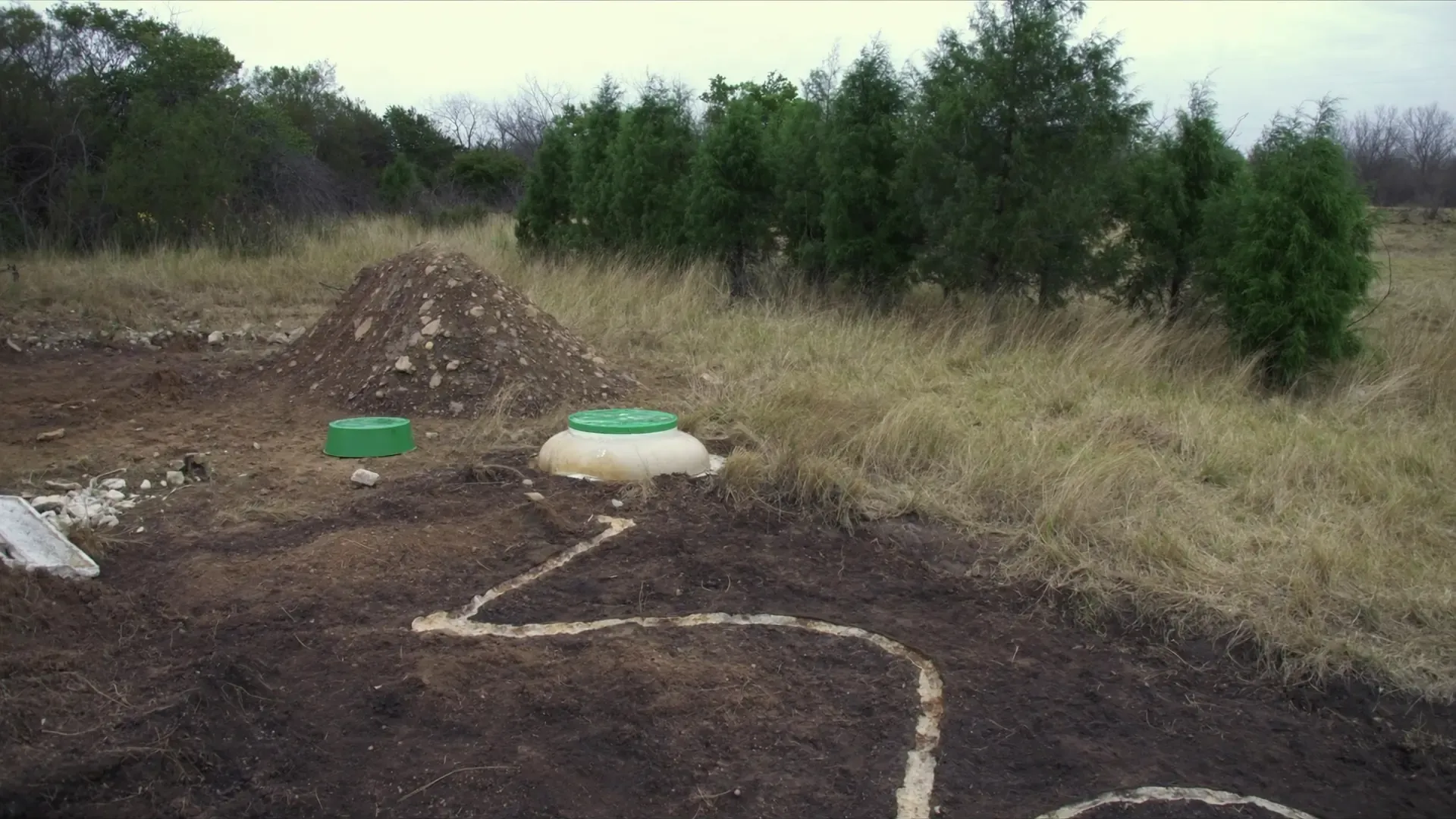
All six counties here, Travis, Williamson, Bastrop, Caldwell, Lee and Burnet, run their own septic program as TCEQ's authorized agent, and the form, the fee and the order of permits change at every county line. The Lower Colorado River Authority takes the lake lots on the septic side, and five electric utilities published a path to a new meter that this page could read, each one different.
Inside a city
Ask the city
Inside Bastrop, Elgin, Smithville, ask that city's own office, because no city page in this county was read for the septic system and this site states a city rule only from the city's own page.
Unincorporated Bastrop County
County septic permit, $1,000 standard commercial and $1,200 non-standard
Septic permits are issued by the Environmental and Sanitation division of Development Services at 211 Jackson Street; TCEQ's directory lists Bastrop County as authorized agent for the entire county except the City of Bastrop, which covers its own city limits.
Source Bastrop County Development Services, environmental and sanitation, and the application fees, read 2026-09-20.
Bastrop County, read at the county's and the city's own pages. The whole record is on that county's sheet.
Who issues the commercial septic permit for a shop or warehouse in the Austin area?
The county's septic office, acting as TCEQ's authorized agent, in all six counties. TCEQ says a permit is required to construct, install, alter, extend or repair an on-site sewage facility, that a local program can be stricter than the state minimum, and that the permitting authority has to approve or deny the planning materials and the application within 30 days of receipt. TCEQ keeps no static list of its agents by county and sends you to its county search, so the table below is read from each county's own page.
The full record for each office sits on its county page: Travis, Williamson, Bastrop, Caldwell, Lee and Burnet.
The septic office and the published fee for a commercial system, county by county, from each county's own page read 2026-09-20.
On a phone this table scrolls sideways.
| County | Authorized agent | The commercial application | Published permit fee | Phone |
|---|---|---|---|---|
| Travis | Travis County Development Services; LCRA within 1,000 feet of Lake Travis | Non-Residential OSSF application, filed separately from the development or driveway permit | Private sewage permit $712 up to 500 gallons a day plus $125 per additional 500; $1,262 engineered; $10 state fee (FY2026) | (512) 854-4215 |
| Williamson | County Engineer's Office OSSF program, except inside the City of Austin | Commercial Questionnaire; commercial means everything but a single-family residence | $810 non-aerobic, $910 aerobic (fee sheet of September 12, 2025) | (512) 943-3330 |
| Bastrop | Development Services, Environmental and Sanitation; the City of Bastrop covers its own limits | Filed with the development permit where no public wastewater is available; single-unit and multi-unit commercial are listed classes | $1,000 standard commercial; $1,200 non-standard commercial designed by an engineer or designer | (512) 581-4042 |
| Caldwell | Sanitation and Development Services; Mustang Ridge, San Marcos, Uhland and Niederwald cover their own limits | Filed with the site construction application and processed together | No commercial fee listed; $400 residential conventional, $450 engineered | (512) 398-1803 |
| Lee | Lee County Sanitation at Development Services, the whole county | Any facility other than a single family residence, designed and sealed by a registered sanitarian or professional engineer | $500 for any other on-site sewage facility | (979) 212-8070 |
| Burnet | Burnet County Development Services; LCRA on the lake zones and Granite Shoals | After the building permit, on a licensed site evaluator's evaluation; in most cases the licensed installer files it | No commercial line drawn: $250 most systems, $400 aerobic | (512) 756-5437 |
SourcesTexas Commission on Environmental Quality, getting a permit for an OSSF such as a septic system, read 2026-09-20; Travis County TNR Development Services, commercial on-site sewage facility permit, read 2026-09-20; Williamson County, on-site sewage facilities, and the OSSF program fee sheet, read 2026-09-20; Bastrop County Development Services, environmental and sanitation, and the application fees, read 2026-09-20; Caldwell County, sanitation and development services, and the septic permit application packet, read 2026-09-20; Lee County Development Services Department, and Lee County Sanitation permit instructions, read 2026-09-20; Burnet County, on-site sewage facilities and development permits, and the TCEQ authorized agent directory, read 2026-09-20.
Where does the septic application sit in each county's order of permits?
In a different place in each county, and filing out of order costs a resubmittal. Each county's page states its own sequence:
Burnet County: a 911 address for any new business first, then the building permit, and the county issues no septic permit until the building permit exists.
Lee County: a 9-1-1 address for any new business before applying for any county permit; the inspection before the system is covered needs three working days' notice.
Bastrop County: where no public wastewater is available, the development permit and the septic application are submitted together.
Caldwell County: the septic application is filed with the commercial site construction application and the two are processed together; the packet says review takes five days after a complete submittal.
Williamson County: when a property's footprint changes, the $25 Certificate of Compliance has to be in hand before a septic application can be processed; construction cannot begin until an Authorization to Construct is granted, and a License to Operate issues after the final inspection.
Travis County: the Non-Residential OSSF application is filed separately from the development or driveway permit, with a soil evaluation and a plot plan showing wells within 150 feet.
SourcesBurnet County, on-site sewage facilities and development permits, read 2026-09-20; Lee County Development Services Department, read 2026-09-20; Bastrop County Development Services, environmental and sanitation, and the application fees, read 2026-09-20; Caldwell County, sanitation and development services, and the septic permit application packet, read 2026-09-20; Williamson County, floodplain management, and the Certificate of Compliance form, read 2026-09-20; Williamson County, on-site sewage facilities, and the OSSF program fee sheet, read 2026-09-20; Travis County TNR Development Services, commercial on-site sewage facility permit, read 2026-09-20.
Which counties make an engineer or a sanitarian sign the septic design?
TCEQ's rule keys the designer to the system and the site, not to the word commercial. Under 30 TAC 285.5(a)(2) the planning materials come from a professional engineer or a professional sanitarian for a non-standard treatment or disposal system, for a multi-unit rental, for a subdivision or development plan, for multiple systems on a large tract, and for every new system in the Edwards Aquifer recharge zone; a non-standard system that needs secondary treatment is designed by a professional engineer alone. Section 285.2 defines a commercial or institutional facility as any building not used as a single-family dwelling or duplex, and 285.32(c)(1) sizes a proprietary treatment system for one from the wastewater flow table in 285.91, which is where a shop with a restroom and a warehouse with a break room part ways from a house. Before any of it, TCEQ says to arrange a site evaluation by a licensed site evaluator or a licensed professional engineer.
Three counties here say something tighter than the state rule, in their own words.
Lee County: any on-site sewage facility other than a single family residence has to be designed and sealed by a registered sanitarian or professional engineer.
Williamson County: a design over the Edwards Aquifer recharge zone or in the 100-year floodplain comes from a Texas registered sanitarian or professional engineer.
Caldwell County: an engineered design is required for Type 1a soil, a floodplain site or a restricted subdivision.
SourcesTexas Commission on Environmental Quality, RG-472 on-site sewage facility rules compilation, 30 TAC 285.5 and 285.32, read 2026-09-20; Texas Commission on Environmental Quality, getting a permit for an OSSF such as a septic system, read 2026-09-20; Lee County Development Services Department, and Lee County Sanitation permit instructions, read 2026-09-20; Williamson County, on-site sewage facilities, and the OSSF program fee sheet, read 2026-09-20; Caldwell County, sanitation and development services, and the septic permit application packet, read 2026-09-20.
Does the ten-acre septic exemption reach a shop or a warehouse?
No. The exemption in 30 TAC 285.3(f)(2) is written for a system serving a single family dwelling on a tract of ten acres or larger, and even there it rides on conditions the rule does not close off. Among them: the system meets the construction standards, it causes no nuisance and no groundwater pollution, it sits at least 100 feet from the property line, the effluent is disposed of on the property, and the dwelling is the only one on the tract. TCEQ's own wording is that the owner might not need a permit and should confirm with the local permitting authority. The exemption is not written for a shop or a commercial building, so a shop on a large tract still goes through the county office in the table above.
SourcesTexas Commission on Environmental Quality, Chapter 285 on-site sewage facilities, adopted rule text, section 285.3, read 2026-09-20; Texas Commission on Environmental Quality, getting a permit for an OSSF such as a septic system, read 2026-09-20.
The lake lots: LCRA, not the county
Inside its zones the Lower Colorado River Authority issues the septic permit. TCEQ's authorized agent directory lists LCRA as the septic permitting authority for the restricted and water quality zones of Lakes Buchanan, Inks, LBJ, Marble Falls and Travis, and for Jonestown, Lago Vista, Lakeway, Briarcliff and Volente, phone (512) 578-3216. Travis County's own page puts LCRA's septic authority within 1,000 feet of Lake Travis and says a county development permit is still required there. Burnet County's page lists LCRA for the lake zones and for Granite Shoals, and links LCRA's jurisdiction map rather than naming which lots fall inside it, so the map and the LCRA phone number answer for one parcel.
LCRA publishes its fees: $260 for a conventional system serving a single-family, multiple-dwelling or commercial structure, and $410 for a professionally designed system, which for a commercial system covers the first 500 gallons a day, plus $45 for each additional 500 gallons a day and $10 for the state research fund. After a site visit and plan review LCRA issues an Authorization to Construct, then a Permit to Operate on completion.
SourcesTexas Commission on Environmental Quality, OARS authorized agent record, Lower Colorado River Authority, read 2026-09-20; Lower Colorado River Authority, on-site sewage facility fee schedule and steps to get a permit, read 2026-09-20; Travis County TNR Development Services, commercial on-site sewage facility permit, read 2026-09-20; Burnet County, on-site sewage facilities and development permits, and the TCEQ authorized agent directory, read 2026-09-20.
What does a new water connection take inside Austin?
A Texas licensed professional engineer, an engineered tap plan, and the tap fees paid before the building permit. New Austin Water connections are installed by the property owner and maintained by the utility. Plans have to be prepared by a Texas licensed professional engineer, and only an engineer may submit the engineered tap plan through the Austin Build + Connect portal. Once the plan is approved you pay the connection fees; no building permit issues until all tap fees are paid, and you need a right-of-way permit before installing the connections. The FY 2025-26 initial tap plan review is $124.22, and a lot platted after October 1, 2023 pays impact fees of $4,800 for water and $2,900 for wastewater per service unit. The Utility Permitting Office is at (512) 972-1000 option 3; the pages state no review time for an engineered tap plan.
In Austin's extraterritorial jurisdiction the city issues no new construction permit and sends you to the county, yet a standalone trade permit for the utility connection is still needed when the property is served by Austin Water or Austin Energy.
Outside Austin Water's lines this site carries no water utility record, so it states nothing about the supplier for a lot in the other five counties; ask the county office in the septic table which one reaches the road. Caldwell County makes water a permit item: its Commercial Site Construction Permit application asks for proof of potable water alongside the concurrent septic and driveway applications.
SourcesAustin Water, new service connections, the utility permitting office, and rates and fees, read 2026-09-20; City of Austin Development Services, relocation permit, and City of Austin Planning, jurisdictional matters, read 2026-09-20; Caldwell County Development Ordinance, revised February 14, 2023, and the subdivision and development fee schedule, read 2026-09-20.
New commercial electric service, utility by utility
Service starts with whichever utility owns the lines on your road. Five utilities' own pages were read for this footprint and they are the five below; a municipal or other provider may own the line on a given road, and the county office or the road itself is what settles that. The fees and day counts below are the ones each utility prints, nothing more.
Austin Energy: a commercial project, or any project over 350 amps single-phase or 225 amps three-phase, gets its site plan approved by the city's Development Services first, then files an intake request in the Austin Build + Connect portal with an Electric Service Planning Application. Austin Energy Design produces the design with a preliminary time frame and estimated fees; you install the civil work and metering, the utility inspects it, you get the city electrical permit, and Austin Energy energizes. The pages state no fixed design fee and no day count.
Pedernales Electric Cooperative: its tariff effective June 1, 2026 lists Burnet, Caldwell, Travis and Williamson among the counties it may serve, not Bastrop or Lee. With no service at the site you stake it, bring site plans, civil plans and electrical diagrams (an approved site plan and plat for commercial work), apply at the nearest district planning office at (877) 372-0391 and pay the $50 membership, $50 establishment and $200 system impact fees. PEC provides one design, with any redesign subject to a redesign fee, gives a cost estimate only after a field meeting, and invoices the extension cost before it builds. No day count is stated.
Bluebonnet Electric Cooperative: 14 Central Texas counties from Travis County to Washington County, with retail centers at Bastrop, Lockhart, Giddings, Manor and Brenham; its service-area page names no counties, and its history page names the 14 counties of its 1939 charter as charter territory rather than as a current service list. New construction starts with a line design appointment booked at (800) 842-7708, loads over 200 amps need an electric load analysis, and a non-residential general service applicant pays all estimated extension costs above $350 per service.
Oncor: the wires company in parts of Williamson County including Georgetown, Round Rock, Taylor, Jarrell and Florence. New construction runs through an online request, a construction portal account, a project manager, and an electric service identifier issued when the site is ready so you can choose a retail electric provider. Its pages state no application fee, deposit or engineering fee.
Bartlett Electric Cooperative: areas of Bell, Burleson, Milam, Williamson and Lee counties. Members pay a $25 membership fee, a $25 connection fee and a $200 staking appointment fee, refunded if the quoted contribution in aid of construction is paid within 90 days of the estimate. No page read describes a commercial line extension policy or a timeline beyond that.
SourcesAustin Energy, apply for electric service, and the City of Austin Utilities commercial fees and deposits page, read 2026-09-20; Pedernales Electric Cooperative, service for individual residential or commercial locations, and the tariff and business rules, read 2026-09-20; Bluebonnet Electric Cooperative, line extensions, line design appointment, and the commercial developers package (revised June 4, 2024), read 2026-09-20; Oncor Electric Delivery, new construction (commercial), read 2026-09-20; Bartlett Electric Cooperative, about us, application for service, and service fees, read 2026-09-20.
What a rural lot has to bring before the steel goes up
An address, a permitted driveway, power to the pad, water on paper, and the septic permit in the county's order. The records for this footprint name these:
A 911 address. Burnet County and Lee County both require one for any new business before any county permit.
A driveway the county or TxDOT has permitted. TxDOT and county driveway permits covers the state highway permit against each county's own culvert rule.
A line extension. PEC invoices the extension cost before it builds; Bluebonnet charges a non-residential applicant everything above $350 per service.
Potable water on paper. Caldwell County's commercial site permit asks for proof of it. Where the answer is a well in the part of Travis or Caldwell County inside the Barton Springs Edwards Aquifer Conservation District, every well has to be registered, a permit is required to drill a new Edwards or Trinity well, and a domestic or livestock well on ten acres or more files a New Exempt Well application with a $450 fee. The district's pages describe nothing that reaches an owner who is not drilling or owning a well.
SourcesPedernales Electric Cooperative, service for individual residential or commercial locations, and the tariff and business rules, read 2026-09-20; Bluebonnet Electric Cooperative, line extensions, line design appointment, and the commercial developers package (revised June 4, 2024), read 2026-09-20; Barton Springs Edwards Aquifer Conservation District, well permits and forms, read 2026-09-20; Burnet County, on-site sewage facilities and development permits, read 2026-09-20; Lee County Development Services Department, read 2026-09-20; Caldwell County Development Ordinance, revised February 14, 2023, and the subdivision and development fee schedule, read 2026-09-20.
The designer, the installer and the county inspector
A registered sanitarian or a professional engineer signs the septic sheets where the record says one has to, and the contractor who walks the lot builds what those sheets and the county office allow. What a shop or workshop and a warehouse each ask of the site is on their own pages, and the whole path from lot to finished building, permit by permit, is in the Austin-area metal building guide.
Asked before pricing
Does a shop or warehouse on septic need a commercial septic permit?
Yes. TCEQ says a permit is required to construct, install, alter, extend or repair an on-site sewage facility, and the application goes to the county's authorized agent. Williamson County defines a commercial structure as everything but a single-family residence, and Lee County charges $500 for any facility other than a single family residence. The ten-acre exemption is written for a single family dwelling, not a shop or a commercial building.
Who has to design the septic system for a warehouse?
Under 30 TAC 285.5(a)(2) a professional engineer or a professional sanitarian prepares the planning materials for a non-standard system, a multi-unit rental, a development plan, multiple systems on a large tract, or any new system in the Edwards Aquifer recharge zone. Lee County requires a registered sanitarian or professional engineer for any facility other than a single family residence, and Bastrop County prices a non-standard commercial design by an engineer or designer at $1,200.
Which electric utility serves a new shop outside Austin?
The one whose lines reach the lot. Pedernales Electric Cooperative's tariff lists Burnet, Caldwell, Travis and Williamson among the counties it may serve, not Bastrop or Lee. Bluebonnet serves 14 Central Texas counties with retail centers at Bastrop, Lockhart, Giddings and Manor. Oncor is the wires company in parts of Williamson County including Georgetown, Round Rock and Taylor, and Bartlett Electric Cooperative serves areas of Williamson and Lee counties.
What does Austin Water charge to connect a new commercial building?
The FY 2025-26 initial tap plan review is $124.22, and impact fees depend on the plat date: a lot platted after October 1, 2023 pays $4,800 for water and $2,900 for wastewater per service unit. Plans have to be prepared by a Texas licensed professional engineer, who submits the engineered tap plan through the Austin Build + Connect portal, and no building permit issues until all tap fees are paid.
Free estimate, six questions
Price a metal building on your land
The county tells a contractor which permit office your lot answers to. The building and the timing tell them what to look at first. Pricing it is free, and you owe nothing either way.
Ready to put a price on the building?
Your request goes to an independent local metal building contractor serving Central Texas, not a national lead list. Pricing it is free, and you owe nothing either way.
Last reviewed 2026-09-20.